A detached ADU rarely gets expensive because of one big decision. More often, the budget moves in small but meaningful ways – a longer utility run, a tighter lot, upgraded windows, a more complex roofline, a city requirement you did not see coming. That is why detached adu construction cost is never just about square footage, especially in San Diego.
For homeowners considering a guest house, rental unit, private office, or multigenerational living space, the real question is not simply, “What does it cost?” It is, “What level of design, site complexity, and finish quality makes sense for my property and goals?” A clear answer starts with understanding what actually drives the number.
What detached ADU construction cost usually includes
When people compare ADU pricing, they often compare only the visible structure. In practice, a detached ADU budget includes much more than framing, drywall, and finishes. It usually covers design development, engineering, permit coordination, demolition if needed, foundation work, framing, roofing, insulation, windows, exterior finishes, plumbing, electrical, HVAC, cabinetry, tile, flooring, fixtures, appliances, and final inspections.
On top of that, detached units often require dedicated site work. That can mean trenching for sewer, water, gas, and electrical lines, new drainage strategies, retaining walls, driveway adjustments, fencing changes, or reworking backyard hardscape. These are not minor details. On many San Diego properties, site conditions are the difference between a straightforward project and one that carries a noticeably higher price.
If you are reviewing estimates, this is where clarity matters. A lower number may simply exclude pieces that will show up later as allowances, change orders, or owner responsibilities. A realistic estimate is not always the cheapest one, but it is the one that gives you a reliable picture of the full job.
Detached ADU construction cost by project scope
The broadest pricing factor is the size and complexity of the unit itself. A compact studio ADU with a simple rectangular footprint, standard finishes, and short utility connections will generally cost less per project than a two-bedroom unit with custom details and extensive site upgrades. But cost per square foot can be misleading on smaller ADUs because kitchens, bathrooms, and mechanical systems are expensive no matter how small the building is.
In San Diego, homeowners often look at detached ADUs in three general tiers. An efficient, smaller unit with practical selections and favorable site conditions sits at one end. In the middle, there are well-designed one-bedroom or two-bedroom ADUs with stronger finish packages, better indoor-outdoor flow, and more thoughtful architectural detailing. At the upper end, there are design-forward detached ADUs that feel like a true extension of a luxury property, with premium materials, larger glass openings, custom cabinetry, elevated bathrooms, and carefully integrated landscaping or hardscape.
That range is wide because the projects are genuinely different. A detached ADU built for long-term rental income has a different budget logic than one intended for aging parents or as a private guest residence behind a high-value coastal home.
The biggest factors that change ADU pricing
Size is only one piece
Yes, larger units usually cost more overall. But doubling the square footage does not always double the budget in a clean, predictable way. Kitchens, bathrooms, utility tie-ins, and permitting carry fixed or semi-fixed costs. That is why very small ADUs can look expensive on a per-square-foot basis.
Site conditions can shift the budget quickly
A flat, accessible backyard is easier to build in than a sloped lot with limited equipment access. If crews need to work around tight side yards, mature trees, retaining walls, or existing outdoor structures, labor and logistics increase. Coastal and hillside conditions can add engineering complexity as well.
This is one of the most common reasons homeowners receive very different preliminary price ranges. Two detached ADUs of the same size can have very different construction paths based on the lot alone.
Utility connections matter more than most people expect
Detached structures need water, sewer, power, and often gas brought to a separate building. If the unit is far from the main house or if the existing systems need upgrades, the cost rises. Older homes can add another layer, especially when the electrical panel, sewer line, or plumbing infrastructure is not ready to support new construction.
Design complexity affects labor and materials
Simple forms are generally more cost-efficient. As the architecture becomes more custom, pricing follows. Vaulted ceilings, large sliding doors, cantilevers, specialty cladding, detailed lighting plans, or a roofline designed to complement an existing luxury home all increase cost. Sometimes these upgrades are worth every dollar because they improve how the ADU lives and how it supports overall property value. The key is making those choices intentionally.
Finish level has a real impact
This is where homeowner priorities really shape the final budget. Stock cabinetry and standard fixtures create one pricing path. Custom millwork, premium stone, designer plumbing fixtures, and higher-end appliances create another. Neither approach is automatically right or wrong. It depends on whether the ADU is meant to be purely functional, highly rentable, or aligned with the quality level of the main residence.
San Diego adds its own cost considerations
Building in San Diego comes with local realities. Labor rates, permit timelines, Title 24 requirements, coastal considerations, and neighborhood-specific design expectations all influence detached ADU construction cost. In more design-sensitive communities, homeowners often want the ADU to look fully integrated with the existing home rather than like a stand-alone afterthought. That usually means stronger architectural detailing and finish continuity, which affects price.
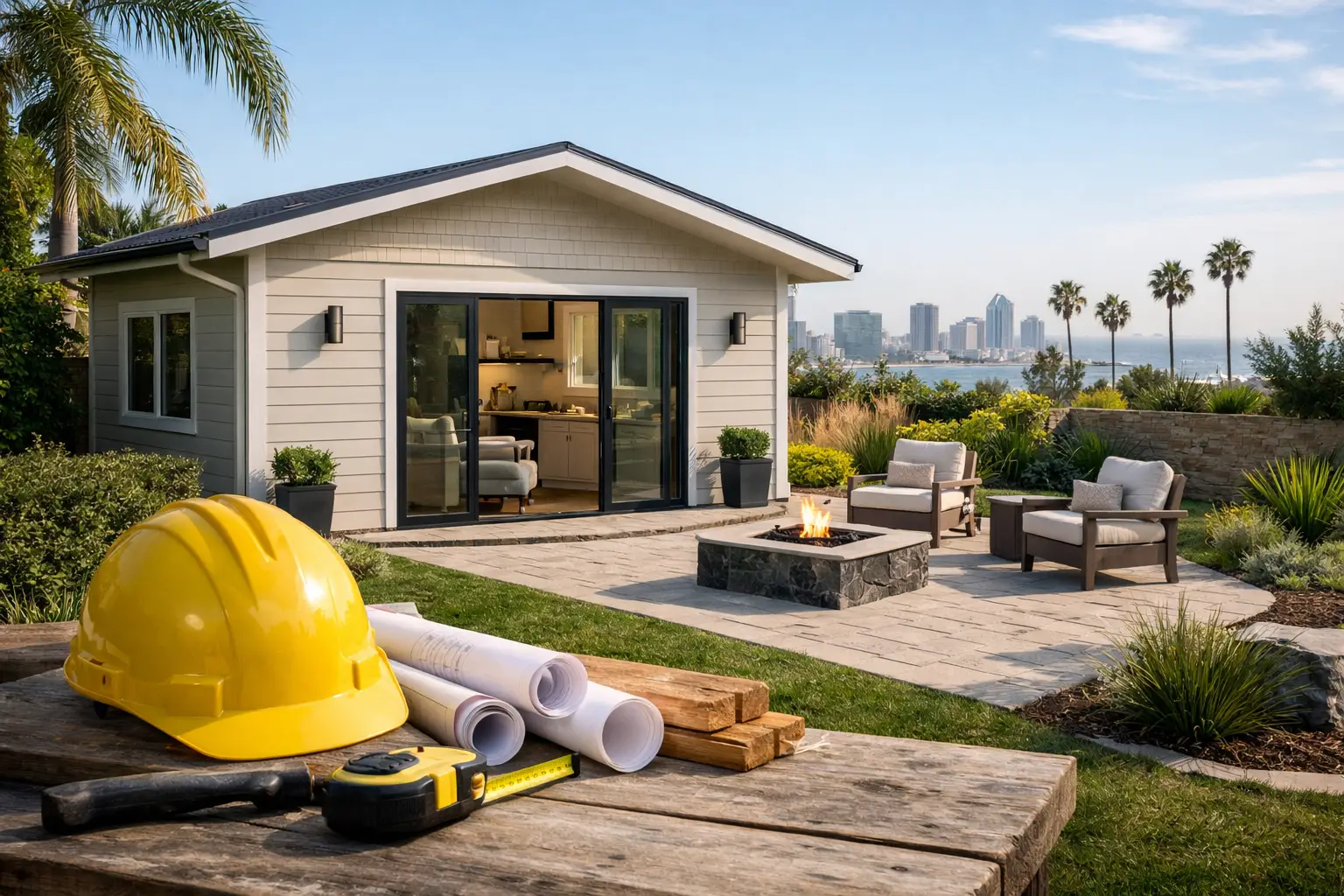
There is also the issue of outdoor living. Many San Diego homeowners want an ADU that opens well to the yard, includes a defined patio area, or preserves the overall flow of the property. That can require careful planning around access, privacy, drainage, and hardscape. It makes for a better result, but it is part of the project cost, not a separate afterthought.
Where budgets go off track
The most common budget problem is starting with an unrealistic benchmark. Homeowners often hear a low per-square-foot number and assume it applies to every detached ADU. It usually does not. Those numbers may leave out site work, utility upgrades, design fees, permit costs, or finish choices that are necessary for the kind of project they actually want.
Another issue is making decisions too late. If layout changes, structural revisions, or material upgrades happen after construction begins, pricing becomes less predictable. A well-organized planning phase protects the budget because it forces the important decisions earlier, when they are easier and less expensive to manage.
Finally, vague proposals create confusion. If an estimate is light on detail, it becomes hard to compare contractors honestly. One bid may include appliances, landscaping repairs, and permit coordination, while another may not. Without a detailed scope, a low number can look attractive right up until the missing pieces catch up with it.
How to plan for the right budget
A smart budget starts with your real purpose for the ADU. If it is for rental income, the focus may be durability, efficiency, and broad market appeal. If it is for family, comfort and accessibility may matter more. If it is meant to match a high-end property, design continuity and finish quality carry more weight.
From there, it helps to separate must-haves from nice-to-haves. Natural light, privacy, and a strong floor plan usually deliver more lasting value than decorative upgrades that can be added later. The same is true for infrastructure. Spending on proper drainage, utility planning, and quality construction is rarely glamorous, but it prevents expensive issues down the road.
This is also where working with a contractor who understands both design and execution makes a difference. A good team will not just hand you a number. They will explain why the number is what it is, where there is room to adjust, and what choices actually move the budget.
Is a detached ADU worth the cost?
For many San Diego homeowners, yes – but only when the project is aligned with the property and the intended use. A detached ADU can create rental income, increase flexibility for family living, add privacy for guests, or improve resale appeal. It can also make your property function better without forcing a full move.
That said, the return is not always immediate or purely financial. Some homeowners build for long-term lifestyle reasons rather than short-term payback. Others care most about preserving the quality and character of the property while adding useful living space. Those are valid reasons, and they often lead to better decisions than chasing the lowest possible construction number.
At Forge & Stone, we see the best ADU projects begin with honest planning. Clear scope, realistic pricing, and thoughtful design create a much better experience than optimistic budgeting followed by constant revisions. If you are considering a detached ADU, treat the budget as a design decision as much as a construction one. The right investment is the one that fits your property, your goals, and the standard you want to live with for years to come.
A detached ADU should feel like it belongs there from day one – not like a compromise you had to price down until the idea stopped making sense.